
How to Choose a PA System for Your Church
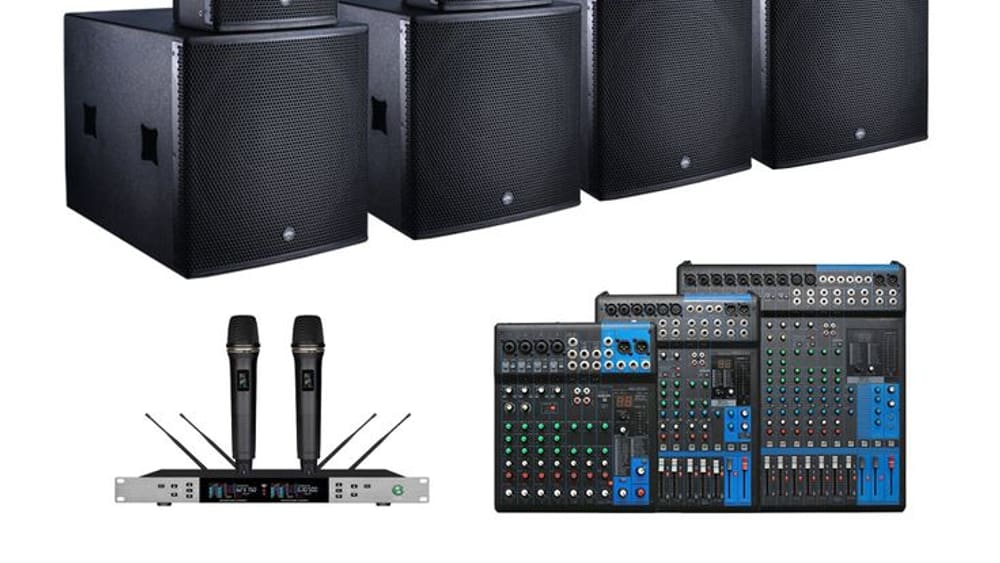
Most churches buy a PA system twice. The first time they buy on price, discover within a year that it distorts when the room fills up, and then buy again properly. This guide is about getting it right the first time.
Start with the room, not the budget
The single biggest factor is not how much you spend — it is the shape of the room you are filling. Before you look at any equipment, measure three things:
- Length and width in metres. A 12m x 8m hall is a very different job from a 30m x 15m one.
- Ceiling height. High ceilings and hard surfaces create echo that makes speech hard to follow no matter how loud you go.
- Seating capacity when full. A room full of people absorbs a surprising amount of sound. A system that sounds fine in an empty hall on Saturday can sound thin on Sunday morning.
Hard floors, iron sheet roofing and bare block walls all reflect sound. Carpet, curtains and a full congregation absorb it. Two rooms of identical size can need noticeably different systems because of what is on the walls.
Work out how many things make sound at once
Count every source that needs its own channel on the mixer:
- Preacher's microphone, plus a spare
- Worship leader and backing vocalists — one channel each
- Keyboard (two channels if stereo)
- Bass, electric guitar, acoustic guitar
- Drums — anything from one overhead microphone to eight channels
- Laptop or phone for playback
Add them up, then add four spare channels. Every church we have ever sold to has grown into more channels than they expected. A 16-channel mixer that costs slightly more than a 12-channel one is far cheaper than replacing the 12-channel one in eighteen months.
Understand what the watts actually mean
Speaker power ratings are the most misunderstood number in audio. A 1000W speaker is not twice as loud as a 500W one — doubling perceived loudness takes roughly ten times the power. What matters more is sensitivity, usually printed as a dB figure, which tells you how efficiently the speaker turns power into sound.
Be sceptical of very high wattage figures on very cheap speakers. Those are often peak or "PMPO" numbers rather than continuous RMS ratings, and the two are not comparable. Ask for the RMS figure.
Powered or passive?
Powered (active) speakers have the amplifier built in. Fewer boxes, less cabling, harder to damage through mismatched wiring. Good for churches without a dedicated technical team.
Passive speakers need a separate amplifier. More components to get right, but easier and cheaper to expand later, and a failed amplifier does not mean a dead speaker. Better if you expect to grow, or if you have someone technical in the congregation.
Neither is better in the abstract. It depends on who will be operating the system on a Sunday morning.
Do not forget the things that are not speakers
Budgets tend to go entirely on the visible boxes, and then the system fails on the invisible parts:
- Cables. Cheap cables are the single most common cause of crackles, hum and dead channels. Balanced XLR for microphones, proper gauge speaker cable for speakers.
- Stands. A speaker on a plastic chair is a speaker that will eventually fall on somebody.
- Power conditioning. Mains supply in much of Kenya is not gentle. A surge protector or conditioner is far cheaper than a replacement mixer.
- Monitors. If the worship team cannot hear themselves, they will sing flat, and no amount of front-of-house power fixes that.
A sensible order of priority
If the budget will not stretch to everything at once, buy in this order:
- Mixer with enough channels to grow into
- Main speakers correctly sized for the room
- Good microphones for whoever speaks most
- Cables and stands, properly specified
- Monitors for the worship team
- Processing — EQ, crossover, effects
A modest system with good microphones and solid cabling will out-perform an expensive system let down at the edges, every single time.
Come and hear it before you buy
Specifications only tell you so much. Tell us the size of your hall, roughly how many people it seats, and what is in your band, and we will put together options at two or three budget levels. You are welcome to come to the shop and listen before you commit.
Visit us at Sukumawiki Building, Tiriki Lane, off Luthuli Avenue in Nairobi, or call and we will talk it through.
More guides
Buying Your First Acoustic Guitar: What Actually Matters
Playability beats looks every time. What to check before you hand over money for a first guitar, and the difference between a cheap guitar and a bad one.
Wireless Microphones: What Actually Matters
UHF versus VHF, why cheap wireless drops out mid-sermon, and how many systems you can safely run in one room. Practical advice for churches, schools and event companies.
Setting Up a Home Studio in a Small Room
You do not need a big budget or a spare building. What to buy first, what to skip, and how to make a small Nairobi room sound far better than it should.